Cat Scratching Posts: Protecting Furniture and Keeping Cats Happy
A practical guide to choosing cat scratching posts, covering furniture protection, materials, placement and training tips for happy cats.
By the Cleos team · 23 August 2027 · 7 min read
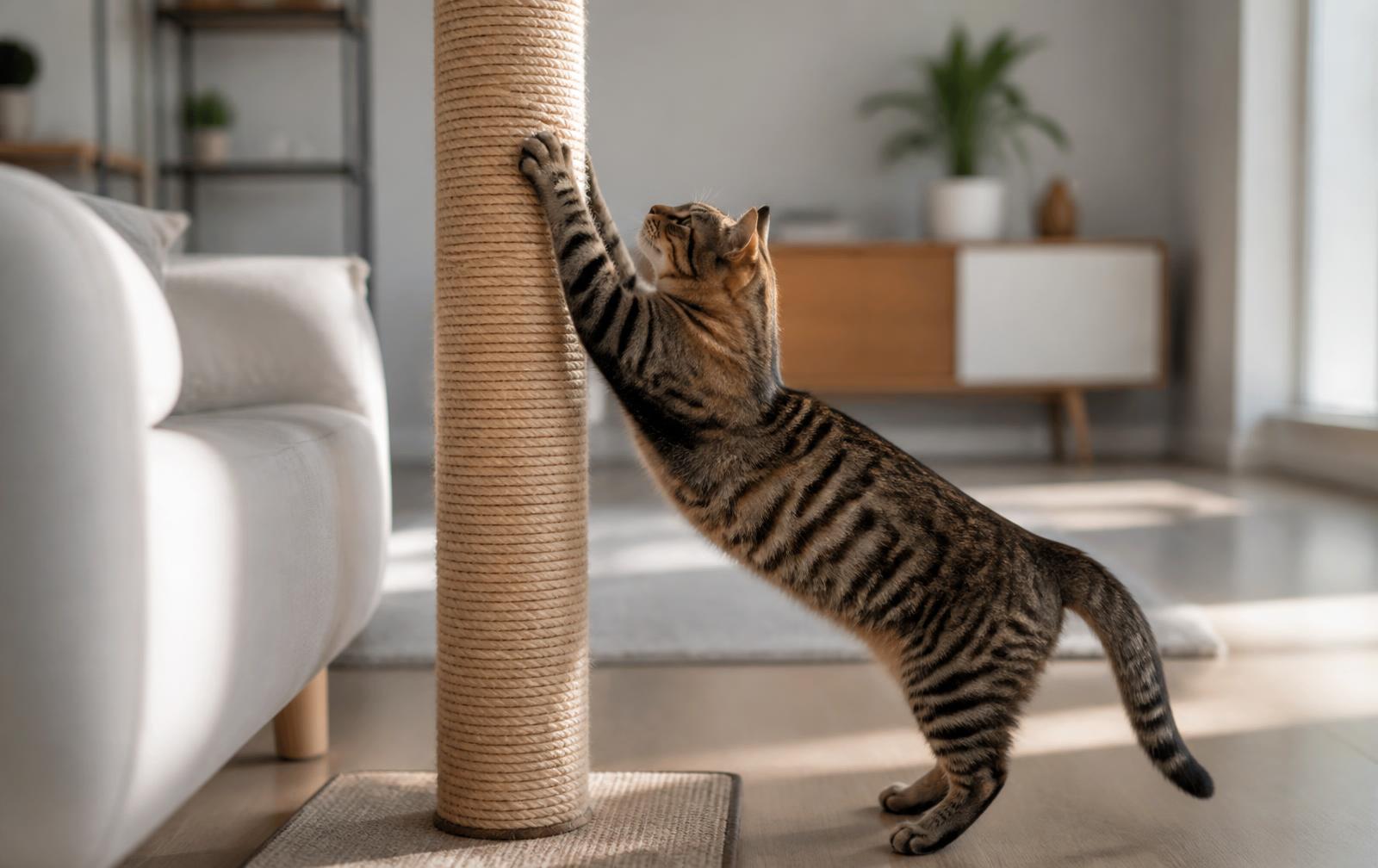
If your sofa arms are looking increasingly shredded, you are not alone. Scratching is one of the most natural behaviours a cat can display, and no amount of scolding will train it out of them. The good news is that a well-chosen scratching post can redirect this instinct almost entirely away from your furniture, provided you pick the right one and place it correctly.
What actually stops cats scratching furniture? In short: give your cat a sturdy, tall enough scratching post covered in a material she prefers, placed where she already likes to scratch, and reward her for using it; furniture damage usually stops once a genuinely appealing alternative is available.
Why Cats Scratch in the First Place
Scratching is not misbehaviour or a sign your cat is untrained. It is instinctive and serves several real purposes at once.
- Claw maintenance. Scratching removes the worn outer sheath of the claw, keeping it healthy and sharp.
- Muscle stretching. The full-body stretch that accompanies scratching works the shoulders, back, and legs.
- Scent marking. Cats have scent glands in their paws, so scratching leaves both a visual mark and a chemical signal for other cats.
- Stress relief. Many cats scratch more when anxious or overstimulated, using the action to self-soothe.
Because the behaviour is instinctive, the goal is never to eliminate it but to redirect it somewhere appropriate. Organisations such as the ASPCA and International Cat Care both recommend providing suitable scratching outlets rather than attempting to suppress the behaviour altogether.
What Makes a Good Scratching Post
Not all scratching posts are created equal, and a flimsy, short post is often worse than having none at all, since cats simply ignore it and return to the sofa.
Height and Stability
A post should be tall enough for your cat to stretch to her full length while scratching, generally at least 75 to 90 centimetres for an adult cat. It must also be completely stable; if it wobbles or tips even slightly on the first attempt, most cats will avoid it for good.
Material
Cats have individual preferences, so it is worth observing what your cat already likes to scratch at home before buying.
| Material | Best For | Notes |
|---|---|---|
| Sisal rope | Cats who scratch carpets or coarse fabric | Very durable, widely preferred by cats |
| Sisal fabric (flat weave) | Cats who like a smoother texture | Slightly less rough than rope |
| Cardboard | Budget-friendly, easy to replace | Popular but wears out faster |
| Carpet | Cats already drawn to carpeted areas | Can confuse cats about which carpet is acceptable |
Orientation
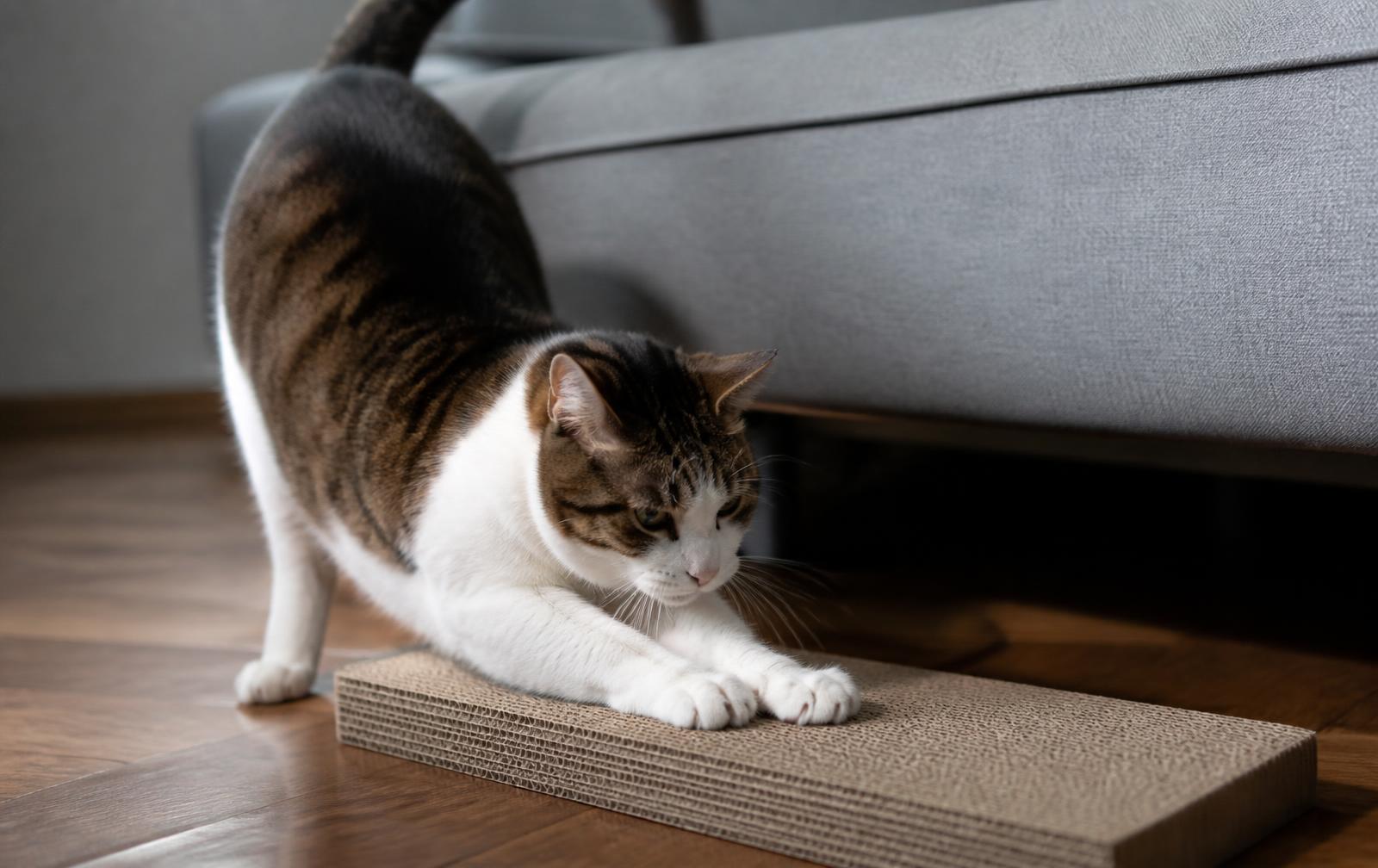
Some cats strongly prefer vertical posts, stretching upward, while others prefer horizontal scratchers they can dig into while lying down. Offering one of each is a reasonable way to cover both preferences if you are unsure.
Where to Place It
Placement matters just as much as the post itself. A perfectly good scratching post tucked away in an unused corner will simply be ignored.
- Put the first post near the furniture your cat currently scratches, then gradually move it to a more convenient spot once the habit is established, moving it only a little at a time.
- Cats often like to scratch right after waking up, so a post near a favourite sleeping spot is a smart addition.
- Multi-cat households benefit from multiple posts in different rooms, since scratching is also territorial and each cat may want her own recognised spot.
Training Your Cat to Use It
Even with the right post in the right place, a little encouragement helps.
- Make the new post more appealing than the furniture. Rub a little catnip into it or dangle a toy near it during play sessions.
- Praise and reward at the moment she uses it. A small lick of a favourite treat right after she scratches the post reinforces the behaviour far more effectively than any correction after the fact.
- Make furniture temporarily less appealing. Double-sided tape or a throw blanket over a favourite scratching spot can nudge her toward the post while the habit forms.
- Never punish scratching after the fact. Cats do not associate delayed punishment with the original action, and it can simply create anxiety, which sometimes worsens scratching. The AVMA advises positive reinforcement over punishment for this exact reason.
A Note on Claw Care and Treats
Scratching posts work best as part of a broader routine that includes regular claw checks and plenty of positive daily interactions. Reward-based training relies on treats your cat genuinely finds motivating, which is part of why we developed Cleos, a lickable treat made with clean, named ingredients and real protein, ideal for those quick positive-reinforcement moments right after good scratching-post behaviour. If you are building out a wider enrichment routine, our piece on why cats love lickable treats explains the science behind why these rewards work so well for training.
For readers dealing with more persistent or destructive scratching habits beyond typical furniture wear, it is worth reading our dedicated guide on managing destructive scratching, which covers cases where a post alone is not solving the problem.
When to Seek Extra Help
If scratching suddenly increases, becomes aggressive, or is accompanied by other behaviour changes, it is worth ruling out stress, pain, or an environmental change as a trigger rather than assuming it is simply a training issue. A veterinary check-up is a sensible first step whenever a well-established cat's behaviour shifts noticeably.
Frequently Asked Questions
How many scratching posts does my cat need?
As a general guide, one post per cat plus one extra, placed in different areas of the home, works well, especially in multi-cat households.
Should I trim my cat's claws as well as providing a post?
Yes, regular nail trims complement scratching posts and further reduce furniture damage, though they should never fully replace a scratching outlet since the behaviour serves several purposes beyond claw wear.
My cat ignores the new scratching post. What should I do?
Try changing the material, height, or location, and reintroduce it with catnip or a treat reward, since preference varies significantly between individual cats.
Are cardboard scratchers as good as sisal posts?
Cardboard scratchers are a fine and affordable option many cats enjoy, though they wear out faster than sisal and are often best used alongside a sturdier vertical post.
Ready to make training time even more rewarding for your cat? Join the Cleos waitlist for a lickable treat she will genuinely look forward to.
Multi-Surface Options: Posts, Boards, and Scratching Furniture
As scratching products have become more sophisticated, options now go well beyond the classic vertical carpeted post. Scratching boards, often made from dense corrugated cardboard set at an angle or laid flat on the floor, appeal to cats who prefer to scratch in a more horizontal or diagonal posture. Wall-mounted scratchers save floor space in smaller flats and can be positioned at exactly the height a particular cat prefers. Increasingly, furniture designers have also begun building scratching surfaces directly into cat trees, ottomans, and even bed frames, which can be a tidy solution if you would rather not have a standalone post as a visible piece of decor. Whatever the format, the same underlying principles apply: it needs to be stable, tall or long enough for a full stretch, and covered in a material your particular cat enjoys digging into.
Common Mistakes Owners Make
Even well-intentioned owners often undermine their own efforts with a few recurring mistakes.
- Buying only one post for a multi-cat household. Cats can be surprisingly territorial about scratching spots, and a single shared post may simply not be used by more timid cats in the household.
- Placing the post somewhere convenient for the owner rather than the cat. A post tucked in a spare room that the cat rarely visits will almost always be ignored in favour of the sofa in the main living space.
- Replacing a well-used post too early. A post covered in shredded sisal strands is not broken, it is doing exactly its job; replacing it prematurely removes a scent-marked surface the cat has already claimed as her own.
- Expecting instant results. It can take several weeks of consistent redirection and reward before a cat fully shifts her habit away from furniture, particularly if the furniture has been scratched for months or years already.
- Using strong-smelling cleaning products on furniture the cat has scratched. Some citrus or vinegar-based cleaners can inadvertently make furniture more interesting rather than less, so it is worth testing on a small area first or choosing a neutral-smelling product.
Building Scratching Into a Wider Enrichment Routine
A scratching post rarely works in complete isolation. Cats who scratch furniture out of boredom or excess energy often benefit from a broader look at their daily enrichment, including interactive play sessions, window perches, and food puzzles that encourage natural hunting behaviours. Pairing a new scratching post with an increase in overall play time and mental stimulation tends to produce faster, more lasting results than introducing the post alone. Reward-based training remains the single most effective tool throughout this process, and having a treat your cat is genuinely excited about on hand makes every redirection attempt more likely to succeed.
Keep Cleos close
Get more Cleos stories on Google
Add Cleos as a preferred source to make our cat care guides easier to find in Google.
Add to Preferred SourcesFound this useful? Share it
Treats worth reading the label for.
Cleos lickable treats are built on real, named ingredients — Real Chicken, Real Tuna, Tuna & Shrimp and Chicken & Veggies — with zero artificial fillers.
Join the Cleos waitlistKeep reading
Travel Carriers and Cat Crates: Stress-Free Transport
Choose the right cat carrier or crate and learn practical tips for calmer vet visits, car trips, and moves with your feline companion.
Read more →
Pet Cameras and Monitoring: Tech for Checking on Your Cat
A practical guide to pet cameras and monitoring systems for cats, covering features, placement, and how to use them without over-worrying.
Read more →
Food and Water Bowls: Material, Design, and Health Considerations
Compare cat food bowls and water bowls by material and design, including stainless steel bowls, to protect whisker health and hygiene.
Read more →