Cat Tree Buyer's Guide: Vertical Space for Indoor Cats
Everything to consider before buying a cat tree, from stability and materials to placement, so indoor cats get the vertical space they need.
By the Cleos team · 9 August 2027 · 7 min read
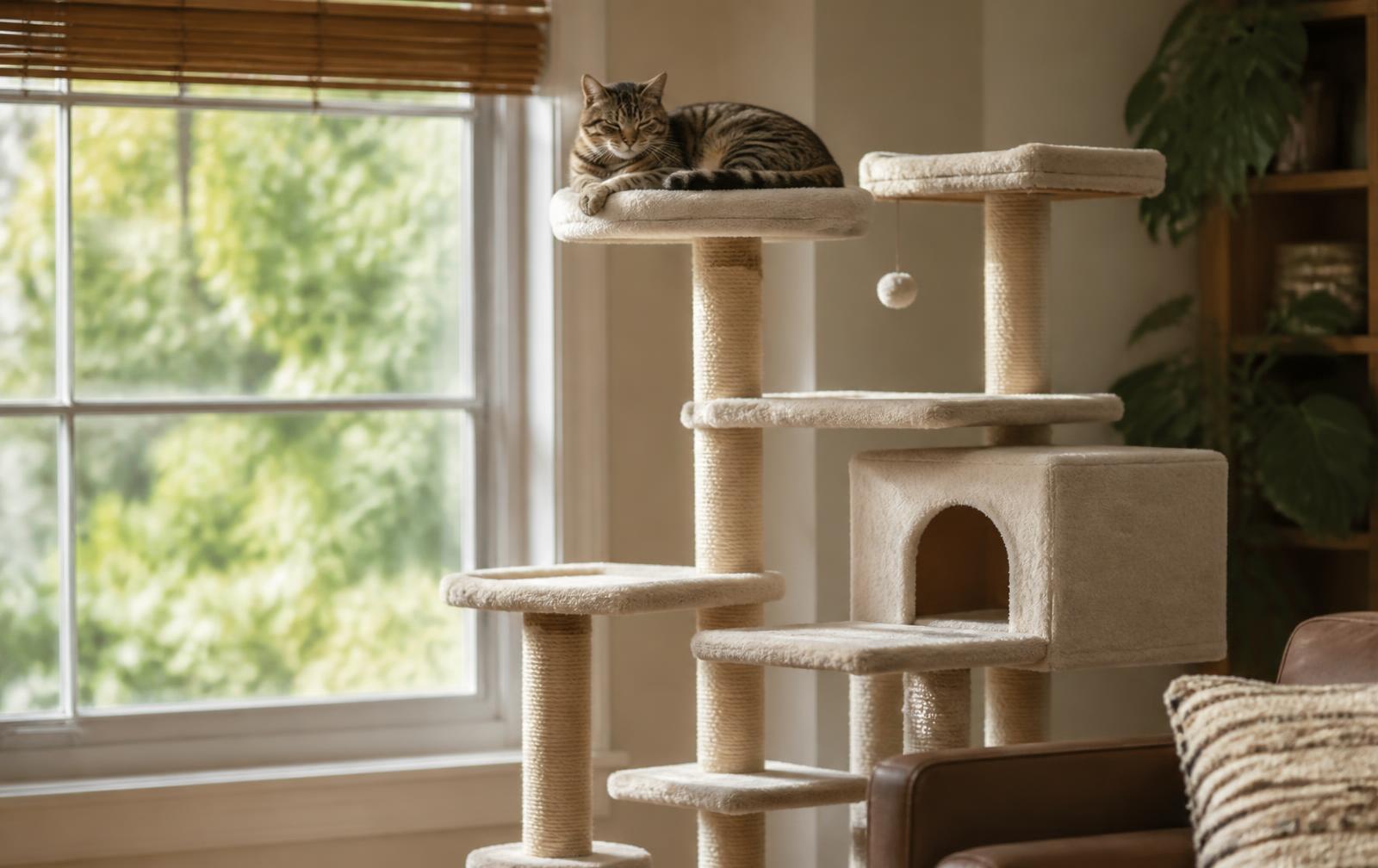
Ask any behaviourist what an indoor cat is most often missing, and vertical space will be near the top of the list. Cats do not experience a room the way we do, as a floor with furniture on it. They experience it as a three-dimensional territory with layers, and the higher layers are the ones they value most.
What should you look for in a cat tree? In short: prioritise a genuinely stable base, at least one perch above human head height, sisal-covered scratching sections, and a footprint that fits a window or a busy room — height and stability matter far more than the number of gadgets bolted on.
Why Vertical Space Matters So Much
Height is not a luxury for cats. In the wild, elevation is safety: it puts distance between a cat and anything unpredictable at ground level, and it offers a wide view of the surrounding territory. Indoor cats keep every bit of that instinct.
- Security. A cat who can retreat upward has an escape route that does not involve hiding under the bed all day.
- Observation. Perching lets a cat monitor doorways, windows and the comings and goings of the household, which reduces the low-level stress of surprise.
- Conflict management. In multi-cat homes, vertical layers let cats share a room without ever having to negotiate the same square metre of floor.
- Exercise. Climbing, jumping and stretching between platforms is meaningful physical activity for an animal who otherwise walks a few dozen metres a day.
Organisations such as International Cat Care consistently list vertical territory alongside food, water and litter as a basic environmental need rather than an optional extra.
Stability Comes Before Everything Else
If you remember one thing from this guide, make it this: a cat tree that wobbles is a cat tree that will be abandoned. Cats test new furniture with a tentative paw before committing, and a single sway on that first attempt is often enough to write the whole structure off permanently.
Look for a base that is wide and heavy relative to the tree's height. As a rough rule, a tree taller than 120 centimetres should have a base at least 45 by 45 centimetres, and taller models should be heavier still. Particleboard bases are common and acceptable if thick, but flimsy 10-millimetre boards on a 150-centimetre tower are a warning sign.
Tall trees are best anchored. Many quality models include a wall bracket or a ceiling-tension pole. If yours does not, a simple L-bracket into a stud costs very little and removes the problem entirely. This is especially worth doing in homes with kittens, senior cats, or anyone likely to land on a top perch at speed.
Height, Perches and Layout
How Tall Is Tall Enough
Most cats are happiest with at least one perch above human head height, roughly 150 centimetres or more. That said, a well-designed 120-centimetre tree placed on top of a low sideboard can deliver the same effective elevation, which is a useful trick in rooms where a full tower would dominate.
Perch Design
Perches should be wide enough for a cat to lie down fully, not just crouch. A 30-centimetre round platform looks generous in a photograph and feels cramped to a five-kilogram cat. Raised lips or bolster edges are appreciated by cats who like to sleep pressed against something.
Spacing Between Levels
Gaps of 30 to 40 centimetres suit most adult cats. Larger gaps become a problem for kittens, overweight cats and seniors with stiff joints, so look for models with steps, ramps, or staggered platforms if your cat is not an athletic three-year-old.
Materials and Coverings
| Element | Common options | What to know |
|---|---|---|
| Scratching posts | Sisal rope, sisal fabric | Sisal rope is the most durable and most preferred; avoid smooth plastic |
| Platforms | Carpet, faux fur, plush | Carpet wears best; plush is cosier but mats over time |
| Frame | Particleboard, solid wood | Solid wood is heavier, quieter underfoot and lasts longer |
| Hideaways | Fabric cubes, wooden boxes | Cats prefer enclosed spaces with two exits where possible |
Check that the covering is stapled or glued down cleanly with no exposed sharp edges, and that any dangling toys use secure cord rather than thin elastic that can be chewed loose and swallowed.
Matching the Tree to Your Cat
A kitten, a nine-year-old with early arthritis and a bold adult who leaps for fun all want different things.
- Kittens. Lower structures with closely spaced levels and plenty of enclosed hideaways. They will graduate to taller trees within a year, so consider a modular design.
- Adult, confident cats. Maximum height, wide top perch, a window view if possible.
- Senior or overweight cats. Ramps or wide staircase steps, generous low platforms, and a top perch no more than a comfortable single hop from the level below.
- Multi-cat homes. More separate perches than cats, ideally at different heights so no one is forced to share eye level with a rival.
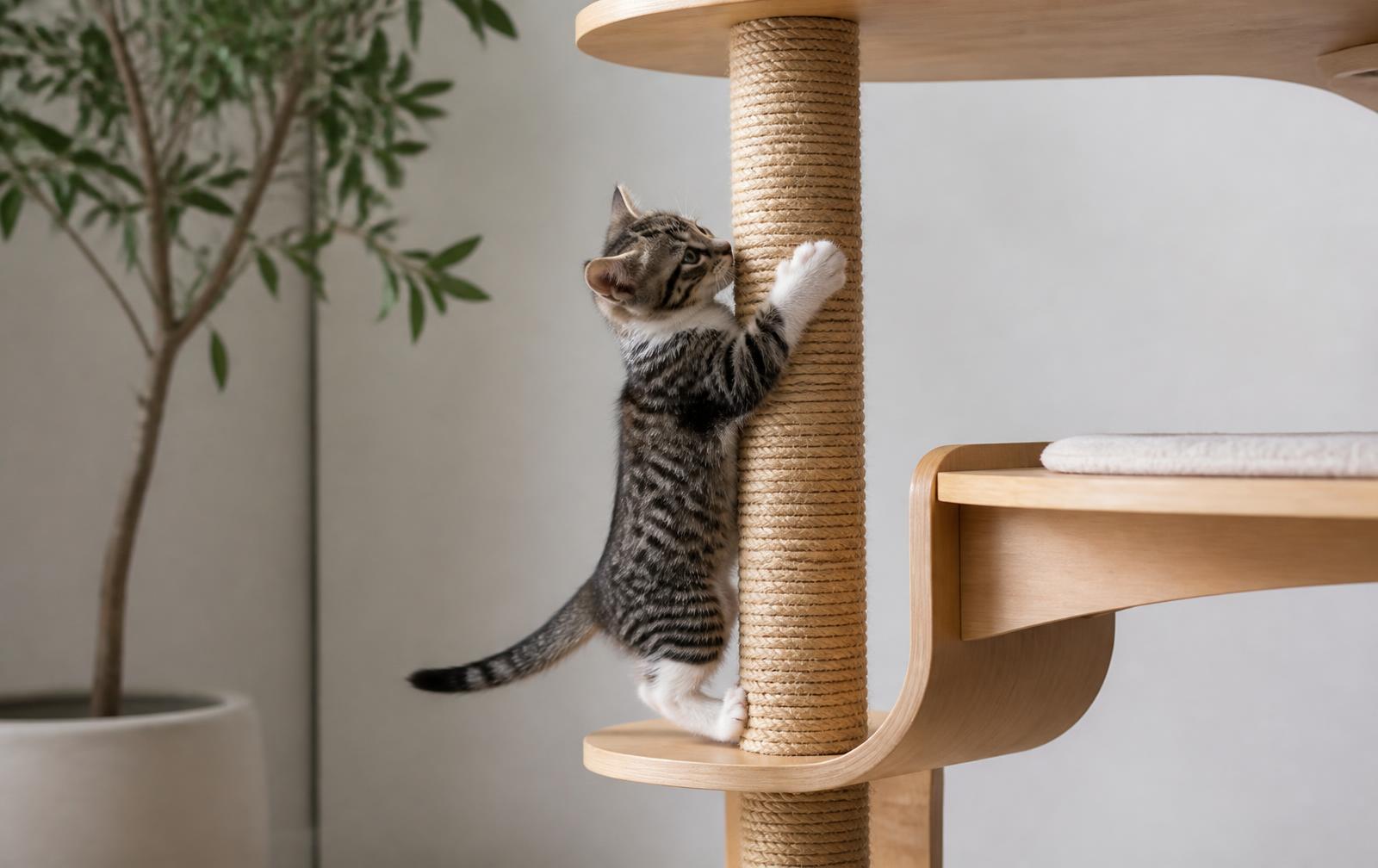
Placement: The Detail Most People Get Wrong
A superb cat tree in a spare bedroom will be used far less than a mediocre one beside the living room window. Cats want to be near the action, not exiled from it.
- Windows first. A view of birds, a street or a garden turns a perch into all-day entertainment.
- Warmth. Near a radiator or a patch of afternoon sun, but not directly against a heat source.
- Social rooms. Cats generally want to be in the same room as their people, watching from above.
- Away from thoroughfares. Not directly beside a slamming door or a washing machine on spin cycle.
If the tree is replacing furniture scratching, put it where the scratching already happens first, then move it gradually — a few centimetres at a time over a couple of weeks — once the habit is established.
Getting Your Cat to Actually Use It
New furniture is suspicious furniture. A little effort in the first week pays off for years.
Rub a small amount of catnip or silver vine into the sisal posts. Play a wand-toy session that ends on the lowest platform, then the next one up. Place a familiar blanket that already smells of your cat on the top perch rather than a brand-new one. And reward the moment she chooses the tree herself: a lick of a favourite treat delivered while she is on the perch does far more than any amount of lifting her onto it, which most cats resent.
If she ignores it entirely for a few days, that is normal. Cats often need to observe a new object at length before approaching it.
Assembly, Maintenance and When to Replace
Tighten every bolt fully at assembly, then re-check them after a month and every few months afterwards, as climbing gradually loosens fixings. Vacuum platforms weekly and use a lint roller between times. Sisal that has gone stringy is not broken — it is working — but rope that has unravelled to bare board should be re-wrapped, which is straightforward with a length of replacement sisal and a staple gun.
Replace the whole tree when the frame flexes under load, when platforms sag, or when repeated cleaning has failed to shift odour from the fabric.
Budget Versus Investment
Inexpensive trees are perfectly serviceable for kittens and for households testing whether their cat cares about vertical space at all. For an adult cat you expect to keep for fifteen years, spending more on a solid-wood frame with replaceable sisal sleeves usually works out cheaper per year and looks considerably better in a living room. The most common regret owners report is not buying a cheap tree, but buying one that was too short.
Frequently Asked Questions
How tall should a cat tree be?
Aim for at least 150 centimetres so your cat has a perch above human head height, though a shorter tree placed on sturdy furniture can achieve the same effective elevation.
Do indoor cats really need a cat tree?
They need vertical space, and a cat tree is the easiest way to provide it. Wall shelves, window perches or cleared bookcase tops can serve the same purpose if a tree does not suit your home.
How many cat trees do I need for two cats?
One tree with several separate perches at different heights can work, but two smaller structures in different rooms usually reduces conflict more effectively.
My cat ignores the new cat tree. What now?
Move it closer to a window or a room the family uses, add catnip to the posts, place a blanket that smells of your cat on the top perch, and reward any use with a treat.
Are carpet or sisal scratching surfaces better?
Sisal rope is more durable and generally preferred by cats. Carpet can also blur the line between the tree and your actual carpets, which is worth avoiding.
Ready to make perch time even more rewarding? Join the Cleos waitlist for a high-protein lickable treat your cat will happily climb for.
Keep Cleos close
Get more Cleos stories on Google
Add Cleos as a preferred source to make our cat care guides easier to find in Google.
Add to Preferred SourcesFound this useful? Share it
Treats worth reading the label for.
Cleos lickable treats are built on real, named ingredients — Real Chicken, Real Tuna, Tuna & Shrimp and Chicken & Veggies — with zero artificial fillers.
Join the Cleos waitlistKeep reading
Travel Carriers and Cat Crates: Stress-Free Transport
Choose the right cat carrier or crate and learn practical tips for calmer vet visits, car trips, and moves with your feline companion.
Read more →
Pet Cameras and Monitoring: Tech for Checking on Your Cat
A practical guide to pet cameras and monitoring systems for cats, covering features, placement, and how to use them without over-worrying.
Read more →
Food and Water Bowls: Material, Design, and Health Considerations
Compare cat food bowls and water bowls by material and design, including stainless steel bowls, to protect whisker health and hygiene.
Read more →