Best Cat Toys: Enrichment That Actually Engages Cats
A vet-informed guide to the best cat toys for real enrichment, covering wand toys, puzzle feeders, and how to rotate them for lasting engagement.
By the Cleos team · 2 August 2027 · 6 min read
Walk into any pet shop and you will find an entire aisle devoted to cat toys, most of which end up ignored under the sofa within a week. The gap between a toy that genuinely engages a cat and one that gathers dust usually comes down to how well it taps into natural predatory behaviour: stalking, chasing, pouncing, and finally "catching" something. Understanding this pattern is the key to buying toys your cat will actually use.
This guide walks through the categories of cat toys worth investing in, how to use them for real enrichment rather than just noise-making, and how to rotate them so cats do not lose interest. In short: the best cat toys mimic prey movement (wand toys, feather teasers), offer mental challenge (puzzle feeders, treat balls), and are rotated regularly, ideally combined with a few short, human-led play sessions each day rather than toys left out permanently.
Why Toy Choice Matters for Indoor Cats
Cats kept exclusively indoors do not stop being hunters; they simply lose the outlet for that instinct. According to the Cornell Feline Health Center, environmental enrichment, including regular interactive play, is an important part of managing stress and preventing behaviour problems in indoor cats. A cat with no appropriate outlet for hunting behaviour may redirect that energy into scratching furniture, pouncing on ankles, or general restlessness.
International Cat Care similarly emphasises that play should replicate the sequence of a real hunt: watching, stalking, chasing, pouncing, and "killing" the toy, followed by a reward. Toys and play sessions that skip straight to the end (just dangling something in front of a cat's face) tend to be far less satisfying than a slower build-up.
The Predatory Sequence
- Watch: the cat notices movement, often from a distance
- Stalk: low, slow approach, often with pauses
- Chase: a short, fast burst towards the "prey"
- Pounce and capture: the toy is caught and often bitten or kicked with the back legs
- Reward: ideally followed by a small treat, echoing the "catch and eat" pattern of a real hunt
Building this sequence into play time, rather than just waving a toy around, produces noticeably more engagement.
Categories of Cat Toys Worth Owning
Wand and Teaser Toys
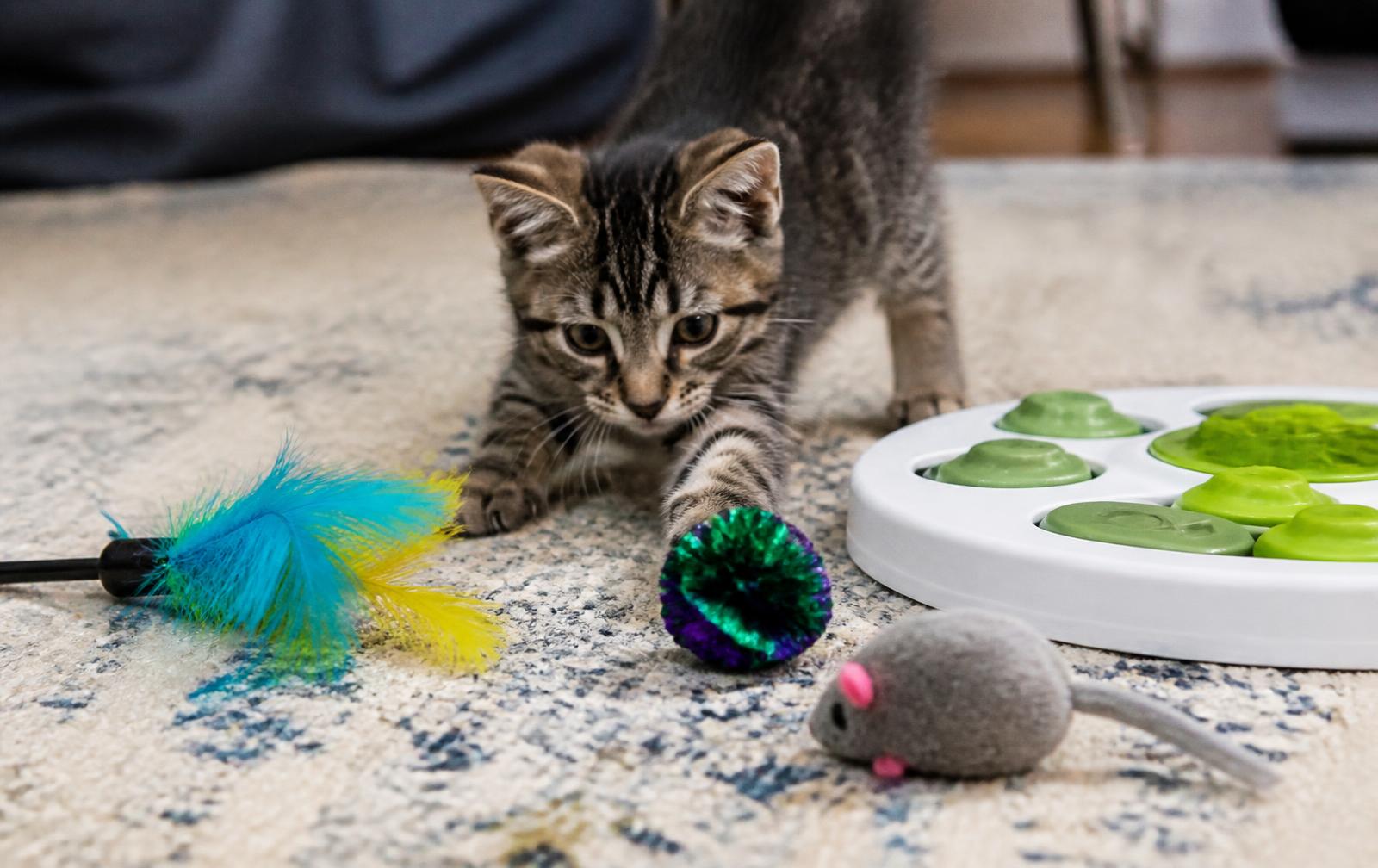
Wand toys, with feathers, fabric strips, or a small lure on the end of a string, are the closest thing to genuine hunting simulation. They require a human to operate them, which is both a limitation (they are not left-out toys) and an advantage, since supervised play is safer and more engaging than solo play.
To use a wand toy well:
- Move it away from the cat, not directly at their face
- Let it "hide" behind furniture occasionally, mimicking real prey behaviour
- Vary speed: slow stalking movements followed by sudden bursts
- Allow the cat to catch it every few minutes so they are not left frustrated
Puzzle Feeders and Treat-Dispensing Toys
Puzzle feeders turn mealtime or treat time into a mental challenge, requiring the cat to nudge, paw, or roll an object to release food. These are particularly useful for cats prone to boredom-related overeating or those who eat too quickly. Introducing a lickable treat like Cleos into a slow-feeder or licking mat can extend the enjoyment of a treat well beyond a few seconds, giving cats a longer, more satisfying session.
Solo Toys (Balls, Mice, Crinkle Toys)
Small balls, catnip mice, and crinkle toys are useful for independent play but should be treated as a supplement to interactive play rather than a replacement for it. Many cats lose interest in a stationary toy within minutes because it stops moving like prey.
Catnip and Silvervine Toys
Not all cats respond to catnip; sensitivity is inherited, and kittens under a few months old typically do not react at all. Silvervine is a useful alternative for cats that are unresponsive to catnip. Both can refresh interest in an otherwise ignored toy.
Comparing Common Toy Types
| Toy type | Best for | Supervision needed | Typical cost |
|---|---|---|---|
| Wand/teaser toy | Active hunting-style play | Yes, always | Low |
| Puzzle feeder | Mental stimulation, slower eating | Occasional | Low to medium |
| Solo ball/mouse | Independent bursts of play | No | Low |
| Cat tree with dangling toy | Combining vertical space with play | No | Medium to high |
| Catnip/silvervine toy | Refreshing interest, calming or exciting play | No | Low |
For cats who enjoy climbing as much as chasing, pairing toys with vertical space is worth considering; see our cat tree buyer's guide for more detail on choosing the right structure.
Building a Rotation System
Cats habituate to toys quickly. A toy that is fascinating on Monday can be entirely ignored by Thursday. Rather than buying more and more toys, most households do better with a smaller collection used on rotation.
A simple system:
- Keep 8 to 10 toys in total, covering wand, puzzle, and solo categories
- Leave only 2 to 3 out at any time; store the rest out of sight
- Swap the available toys every few days
- Retire any toy showing wear (frayed string, loose small parts) immediately for safety
Safety Considerations
- Always supervise play with string, ribbon, or small feathers, as these can be swallowed and cause serious intestinal blockages
- Check toys regularly for loose eyes, bells, or other small parts
- Store wand toys away after play rather than leaving the string accessible
- The ASPCA advises pet owners to be cautious with any toy containing small, detachable parts, particularly around kittens
How Much Play Is Enough
There is no single universal figure, but most behaviourists recommend multiple short sessions rather than one long one. Two to three sessions of 10 to 15 minutes, spread across the day, tend to work better than a single long session, particularly around the times cats are naturally more active (early morning and early evening). Pairing the end of a play session with a treat, such as a lickable Cleos treat, helps close out the "hunt, catch, eat" cycle in a way that feels complete to the cat and can also support bonding treat time rituals between cat and owner.
Frequently Asked Questions
What is the single best toy for an indoor cat?
There is no single best toy for every cat, but a wand or teaser toy used in short, supervised sessions tends to produce the most reliable engagement because it mimics real prey movement.
Why does my cat ignore expensive toys but play with a cardboard box?
Cats are drawn to novelty, texture, and the ability to hide or stalk from cover. A box often satisfies these instincts better than a toy that does not move or offer concealment. Rotating toys and incorporating boxes or tunnels alongside dedicated toys usually works best.
Is catnip safe to use regularly?
Yes, catnip is generally considered safe and non-addictive for cats who respond to it, though effects are usually brief (around 10 minutes) followed by a temporary refractory period before the cat responds again.
How do I know if my cat is bored rather than just resting?
Signs of under-stimulation can include excessive vocalising, overgrooming, destructive scratching, or pouncing on feet and ankles. If these behaviours are frequent, increasing structured play time and enrichment is worth trying before assuming a behavioural problem.
Ready to make treat time part of your cat's daily enrichment routine? Join the Cleos waitlist to be first to try our lickable treats.
Keep Cleos close
Get more Cleos stories on Google
Add Cleos as a preferred source to make our cat care guides easier to find in Google.
Add to Preferred SourcesFound this useful? Share it
Treats worth reading the label for.
Cleos lickable treats are built on real, named ingredients — Real Chicken, Real Tuna, Tuna & Shrimp and Chicken & Veggies — with zero artificial fillers.
Join the Cleos waitlistKeep reading
Travel Carriers and Cat Crates: Stress-Free Transport
Choose the right cat carrier or crate and learn practical tips for calmer vet visits, car trips, and moves with your feline companion.
Read more →
Pet Cameras and Monitoring: Tech for Checking on Your Cat
A practical guide to pet cameras and monitoring systems for cats, covering features, placement, and how to use them without over-worrying.
Read more →
Food and Water Bowls: Material, Design, and Health Considerations
Compare cat food bowls and water bowls by material and design, including stainless steel bowls, to protect whisker health and hygiene.
Read more →